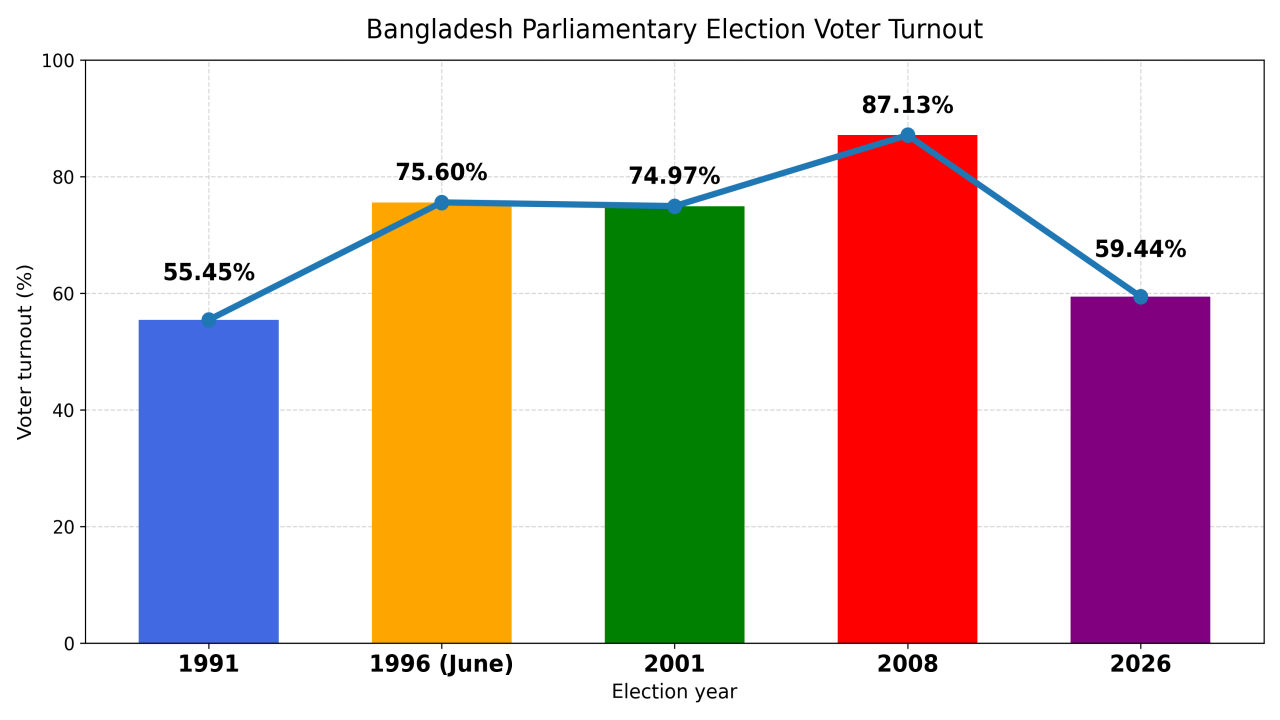
Since Bangladesh's independence, five parliamentary elections have been held under caretaker or interim governments. Leaving aside the first in 1991, the February 2026 election recorded the lowest turnout of them all. The official figure is 59.44%, a number many people doubt, though I won't enter that debate here.
The last caretaker-government election, in 2008, saw a turnout of 87.13%. The earlier ones averaged roughly 75%.
Expectations for the 2026 election were higher than for any before it: the massive 2024 movement, 18 months of social media lamentation over not having been able to vote since 2008, and enormous enthusiasm among young people. Yet turnout was 27% lower than in 2008. That gap is hard to explain.
The government kept the country's oldest party, the Awami League, out of the race, and the party's top leadership instructed supporters not to vote. It is unrealistic to think that millions of voters would all abstain on a party leaders' word alone, and many Awami League supporters we know did vote. Still, if we count the 27% as Awami League votes, then the party retains the support of more than 30% of the electorate: the 27% who stayed home plus those who did vote.
Compare this with the February 1996 election, which the Awami League boycotted and actively resisted. This time the party was not even on the field, and no one resisted the polls. The 27% abstention can therefore reasonably be read as a silent protest.
For 18 months before the election, the BNP, Jamaat, the NCP and the interim government kept the media heated by branding the Awami League as murderers, fascists, corrupt and agents of India. Nearly all of its leaders are imprisoned or abroad, and hundreds of thousands of its activists are in jail. If, after all this, one-third of the country still supports the party, we will have to rethink everything.
Can we really call this a legitimate election when so many citizens chose not to take part? A government elected on this turnout will struggle to restore stability, because a large part of the public does not see the election as having represented them.
This is needless to say a free and fair election with the participation of all parties is urgently needed to restore law and order in Bangladesh.