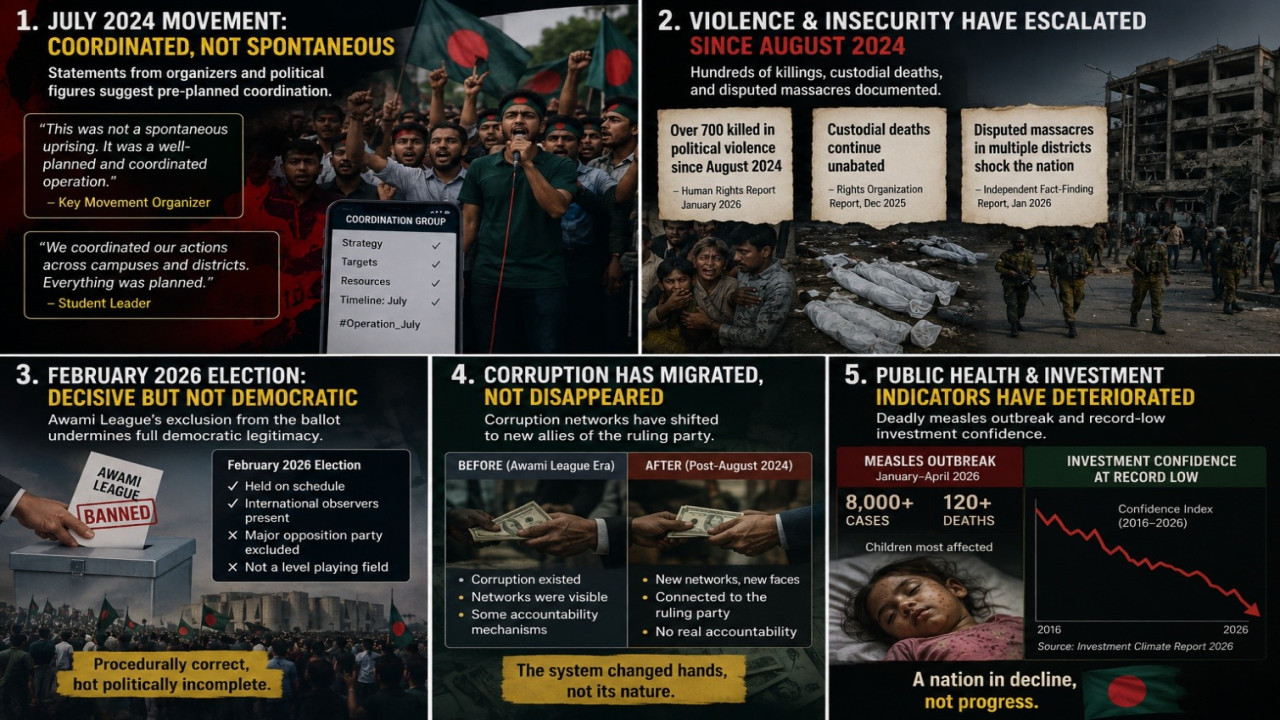
Bangladesh's political order since the so called July - August 2024 uprising, now under Prime Minister Tarique Rahman's BNP government, has marked a net regression rather than a democratic renewal. Debate continues over whether that uprising was spontaneous or coordinated, with statements from figures like Muhammad Yunus and Mahfuj Alam suggesting significant advanced planning.
The BNP government's first seven months (February - Sept 2026) stand in sharp contrast to the "developmental golden period" of the 2009 - 2024 Awami League era, which saw strong GDP growth, poverty reduction, near-universal electrification, and falling child mortality. Since 2024, the country has instead seen over 600 killings in the government's first 100 days, the July 2025 Gopalganj massacre, and a February 2026 election deemed procedurally valid but not fully legitimate due to the Awami League's exclusion from the ballot.
Corruption appears to have migrated to new ruling-party networks rather than being eliminated, including central bank politicization, transport-sector extortion, and cost overruns at the airport third terminal and Dhaka-Ashulia expressway. Investment confidence has collapsed, violence against women and children has worsened, and Awami League-affiliated figures have faced persecution through arrests and custodial deaths.
A measles outbreak killed over 800 children by July 2026, driven by collapsed immunization and healthcare capacity.
Until these failures are confronted and reversed, Bangladesh risks trading one era of unaccountable power.